

How to Read the Silhouette of Antique Furniture
A knowledgeable dealer can often recognise the period and quality of a piece of furniture from across a room. That first judgement is not mysticism, and it is not based on spotting one fashionable leg or handle. It comes from an accumulated understanding of silhouette: the complete outline created by the carcass, top, legs, feet, cornice, supports and the spaces between them.
Silhouette is the first stage of dating antique furniture because design is visible before construction. It tells you whether the object has the visual grammar of the period claimed. Close examination must still confirm the opinion, but it should begin with a question formed by the whole piece.
This guide explains how to form that first question properly.
What silhouette means in furniture
Silhouette is more than the outside edge. It includes:
- the overall height-to-width relationship;
- the depth suggested by projecting tops, feet and supports;
- the division between upper and lower sections;
- the rise and fall of aprons and stretchers;
- the shape and visual weight of legs and feet;
- the rhythm of doors, drawers and openings;
- the negative spaces between supports;
- the way a cornice, waist or base finishes the design.
When viewed from a distance, surface colour and small ornament become less dominant. What remains is the structure of the design.
A fine piece usually has a coherent hierarchy. The eye understands what is supporting what. The principal mass, secondary divisions and terminal features belong together. A poor copy may reproduce individual period details but fail to achieve that relationship.
Why experienced eyes begin at a distance
Close details can be persuasive and misleading. A replacement drawer can contain hand-cut dovetails. Old handles can be fitted to a later chest. Historic timber can be reused. Artificial wear can be placed where a buyer expects to find it.
The silhouette is harder to fake successfully because it depends upon the maker’s complete understanding of a design tradition.
Distance also prevents one attractive detail from controlling the assessment. A highly figured veneer or elaborate carving can distract from a carcass that is too deep, legs that are too short or a cornice that overpowers the whole.
The first examination should therefore happen before drawers are removed or the furniture is turned over.
Stand far enough away to see the whole piece without moving your eyes. If possible, view it:
- directly from the front;
- from both front corners;
- from the side;
- at approximately the height from which it was intended to be seen;
- without surrounding objects interrupting its outline.
Photographs taken square-on can help, but a camera flattens depth and may distort proportion. The object itself remains the primary evidence.
First question: does the piece have presence?
“Presence” is often used loosely in the antiques trade, but it can be analysed.
A piece has presence when its scale, line, mass and detail resolve into a confident whole. Presence does not require size or ornament. A small, restrained table can possess it; a monumental cabinet can lack it.
Look for:
- a clear relationship between the main body and its support;
- lines that lead naturally from one component into another;
- a convincing transition from top to base;
- sufficient visual strength at structural points;
- controlled contrast between straight and curved elements;
- ornament subordinate to the architecture;
- a sense that nothing is apologetic, exaggerated or accidental.
This is not the same as personal taste. One may dislike a period style yet still recognise whether its design is well resolved.
Read the main mass before the details
Mentally remove handles, mounts, carving and surface decoration. What shape remains?
For case furniture, consider the main block of the carcass. Is it tall and architectural, low and horizontal, rectilinear, bombé, serpentine or bowed? Are projections deliberate? Does the depth look appropriate to the height and intended function?
For tables, compare the top with its base. Does the base occupy enough visual and physical area to support the top? Are the legs positioned where the design suggests the load should fall? Does the apron strengthen the form or appear as a separate box beneath it?
For chairs, read the relationship between back, seat and underframe. Is the back visually supported by the rear legs? Does the seat appear suspended, grounded or deliberately light? Do stretchers and rails reinforce the same character?
This reduced outline is often the quickest way to detect a later top, altered base or set of replacement feet.
Proportion: the structure beneath style
Proportion is not a universal formula. Different periods deliberately sought different effects, and regional furniture may depart from metropolitan ideals. Nevertheless, proportions within a genuine piece normally relate to one another.
Vertical divisions
On cabinets, bookcases and tall chests, examine the relationship between cornice, upper case, waist, lower case and feet. A cornice should visually finish the piece without crushing it. A waist should connect sections rather than merely conceal a join. Feet should complete the descent of the design.
A replaced base can make an upper section appear top-heavy. A reduced cornice may leave the elevation abruptly unfinished.
Drawer rhythm
Drawer fronts often form a graduated rhythm. Depths may increase downwards, or small upper drawers may establish a deliberate opening sequence. Even when drawers are equal, the spacing of rails and the scale of handles should support the elevation.
A drawer inserted from another piece may disturb that rhythm before differences in dovetails or timber are noticed.
Width and depth
Depth is frequently overlooked in photographs. An early cabinet, bureau or chest may have a characteristic relationship between frontal width and side depth. Later copies sometimes become too shallow for modern convenience or excessively deep because the maker has copied the front without fully understanding the form.
View the piece from a front corner. The side elevation should agree with the promise made by the front.
Case study: a British cabinet on stand, about 1700
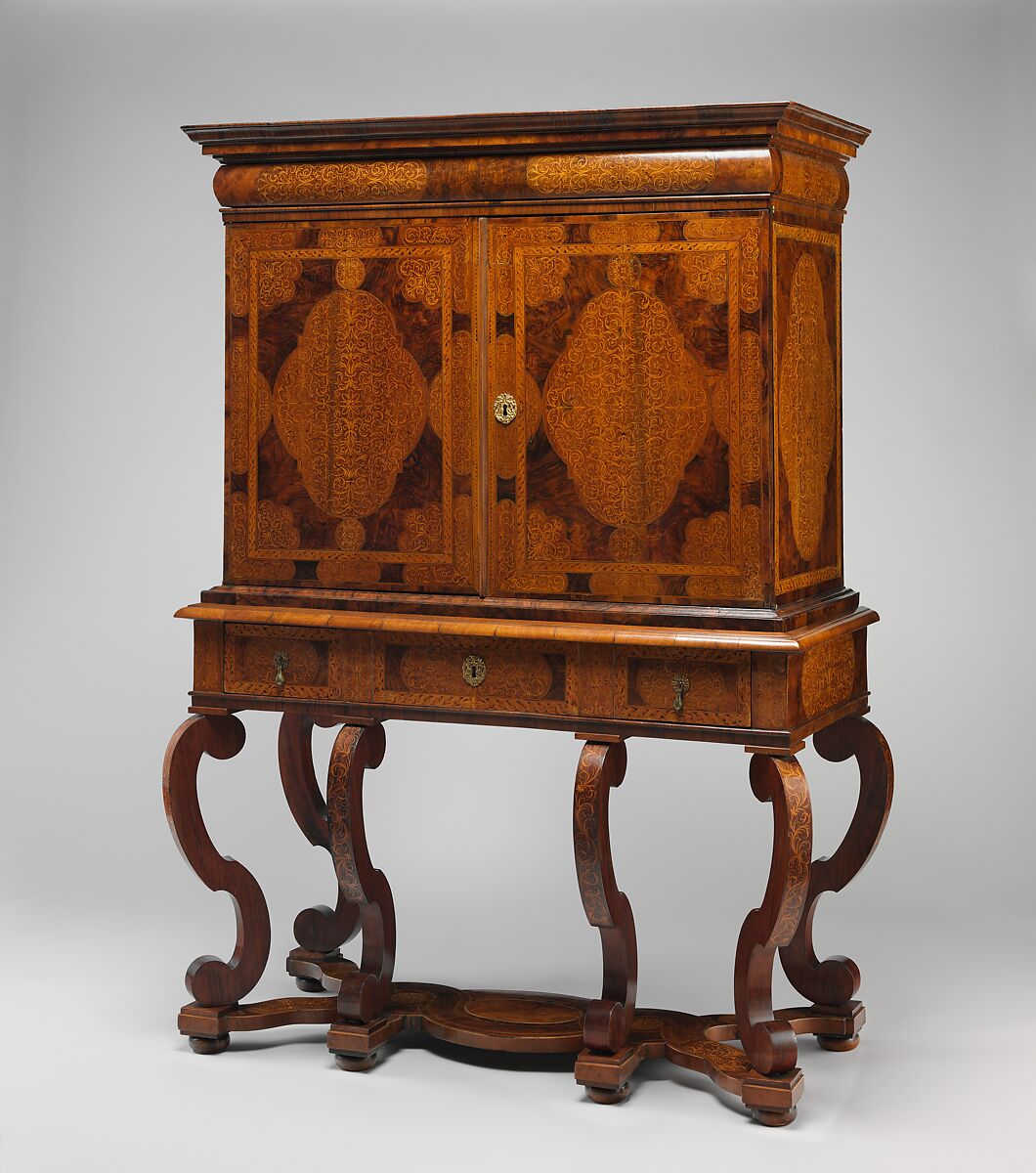
British cabinet on stand, about 1700. Pine veneered with walnut, burr walnut and holly marquetry; oak drawers and walnut legs. The Metropolitan Museum of Art, object 66.64.15. Public domain.
Viewed at a distance, this cabinet has two distinct masses: a substantial upper cabinet and an open, rhythmical stand. The stand is not visually incidental. Its legs, apron and lower spacing mediate between the weight of the cabinet and the floor.
Before looking at marquetry or drawer construction, ask:
- Does the width of the stand answer the width of the cabinet?
- Is the cabinet centred convincingly?
- Does the height of the stand provide an appropriate interval beneath the upper mass?
- Do the supports have enough strength for the cabinet without appearing clumsy?
- Does the base repeat or complement the vertical divisions above?
Cabinets on stands are especially vulnerable to alteration. Stands were damaged, replaced, reduced or exchanged as fashions changed. A cabinet may be genuinely late seventeenth-century while the present stand is later. The silhouette can raise that possibility; construction and surface must then test it.
The Met records some brass hardware on this example as replaced. That is a useful reminder that a piece can retain a coherent period silhouette even where certain fittings have changed.
Negative space is part of the design
The empty spaces between legs, stretchers and aprons are as important as the wood around them.
In a well-resolved table or stand:
- openings have deliberate shapes;
- curves create controlled tension;
- repeated spaces establish rhythm;
- stretchers occupy a visually logical height;
- supports do not crowd or abandon the central space.
Later alterations often disturb negative space. Shortened legs compress it. Missing stretchers leave it too open. Added brackets fill areas that were intended to remain clear. A base assembled from unrelated components may contain several different spatial rhythms.
Squinting slightly, or viewing a darkened photograph of the furniture, can help the eye read mass and void without being distracted by detail.
Lines must continue through the object
Trace the principal lines with your eye.
A curve beginning at a knee may continue into the leg and foot. A shaped apron may relate to the movement of the top. A cornice projection may be answered by the base moulding. Uprights may align with drawer divisions, doors or supports.
Breaks in that logic deserve investigation:
- a moulding that terminates unexpectedly;
- a leg that meets the carcass without a convincing transition;
- a foot set too far inward or outward;
- a top whose edge profile belongs to a different design;
- a stand wider or narrower than the cabinet above;
- carving that does not follow the structural line.
None proves alteration by itself. It identifies where close examination should begin.
Case study: two British cabinets on stands
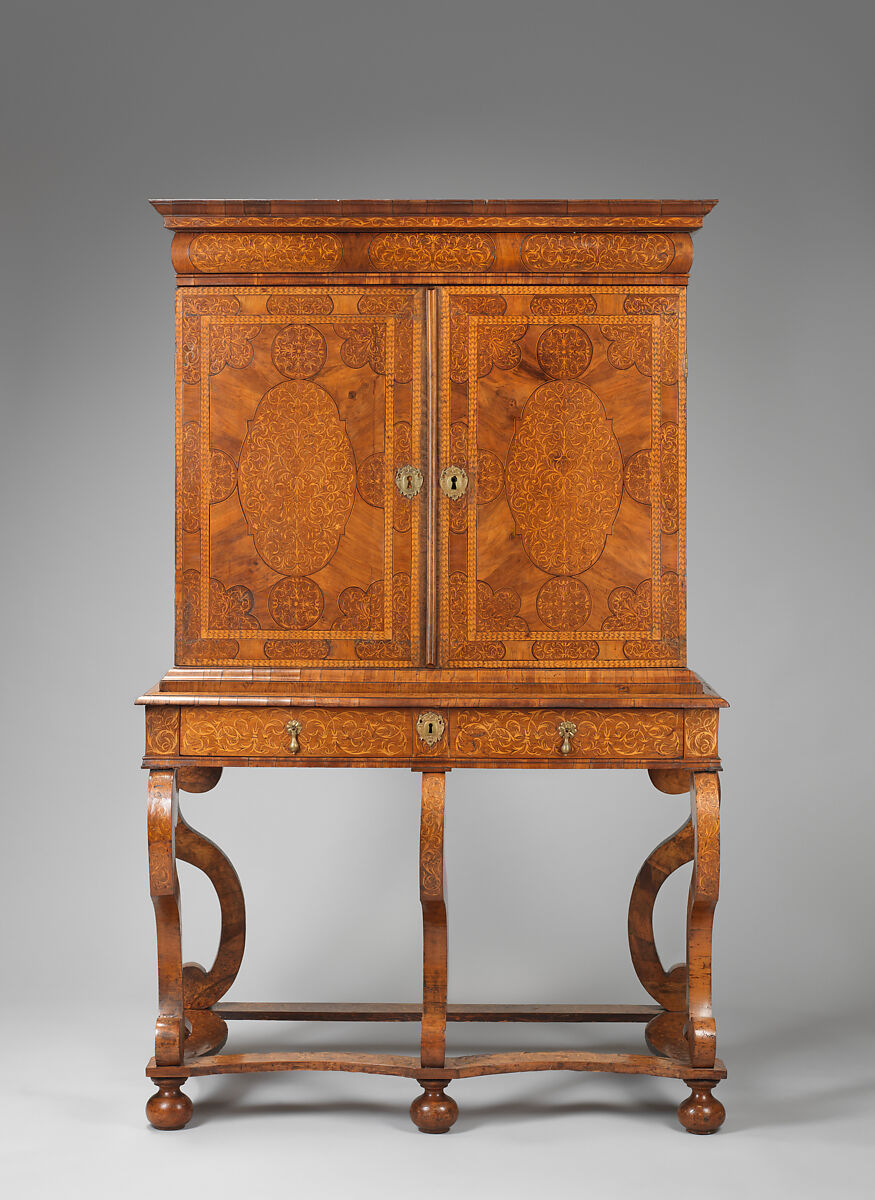
British cabinet on stand, about 1695–1700. Pine veneered with walnut, burr walnut and holly; oak drawers. The Metropolitan Museum of Art, object 26.260.16. Public domain.
Compare this documented example with the previous cabinet. They belong to a related period and form, but they are not identical templates.
The exercise is not to memorise one outline as “correct.” Instead, compare how each maker solved the same design problem:
- the proportion of cabinet to stand;
- the apparent weight carried by each support;
- the shape of the open lower area;
- the relationship between vertical divisions and legs;
- the emphasis created by the top and base.
Authentic period furniture permits variation. Understanding the design family is more valuable than expecting every piece to match a textbook illustration.
This comparison also demonstrates why measurements matter. The first cabinet is recorded by the Met as approximately 159.4 cm high, 116.2 cm wide and 53.3 cm deep. The second is approximately 164.5 cm high, 99.7 cm wide and 78.1 cm deep. A frontal photograph alone does not communicate the substantial difference in depth.
Legs and feet: the final punctuation
Legs and feet terminate the design and are among the parts most often altered.
Begin by asking whether their visual weight belongs to the carcass or top. Then consider their position, height, rake, curvature and relationship to rails or aprons.
Warning signs include:
- feet of slightly different scale;
- legs positioned inconsistently from the corners;
- a design that seems unnaturally low;
- abrupt changes in timber or colour at the junction;
- mouldings that stop where a different base may once have begun;
- plugged fixing holes;
- fresh blocks or screws;
- wear that does not continue across the junction.
Reduced furniture can still be antique, but it should be described accurately. A chest that has lost bracket feet may appear squat from across the room. The visual concern should lead directly to examination underneath.
Replacement feet are not always recent. An eighteenth-century chest may have received new feet in the nineteenth century, and those replacements may now possess convincing age. Date the main carcass and the feet separately.
Tops, cornices and crests
The upper edge carries disproportionate visual importance.
A table top must relate to the spread and direction of the base. Too much overhang can make a base appear weak; too little can make the whole object seem pinched. Changes to the top may also alter the intended relationship between straight and curved lines.
Cornices and crests announce the architectural character of case furniture. Check:
- projection;
- height;
- moulding sequence;
- alignment with the carcass;
- correspondence with the base;
- whether mitres and returns are properly resolved.
A replacement cornice may be made from old timber and carry hand-worked mouldings. Its design relationship to the carcass can reveal the problem before the material does.
Chairs: line, stance and sets
Chairs require a slightly different eye because their silhouette includes both structure and the sitter’s implied body.
View the chair squarely from the front and side. Examine:
- the rise and width of the back;
- the relationship between crest rail and splat;
- the transition from rear legs into back uprights;
- the seat’s depth and pitch;
- the stance and rake of the legs;
- the depth and shape of the apron;
- the pattern created by stretchers.
A chair should not be judged only by the splat or leg type. Those features were copied and revived. The whole stance matters.
When examining a claimed set, line the chairs up. Differences in height, seat width, rake, crest shape and negative space are often more revealing than small variations in carving. Genuine sets can have workshop variation and replacements, but the underlying design should remain coherent.
Curves and controlled movement
Curved furniture is particularly revealing because an awkward line is difficult to hide.
On cabriole legs, follow the transition from the block or knee through the outward and inward curves to the foot. The movement should be continuous even where carved ornament changes the surface.
On serpentine, bombé or bowed case furniture, examine whether:
- the top follows the carcass;
- drawer fronts continue the intended curve;
- side transitions are controlled;
- mouldings maintain their profile around the movement;
- hardware placement supports rather than fights the curve.
The Met’s chest attributed to John Goddard provides a strong documented example of silhouette as attribution evidence.
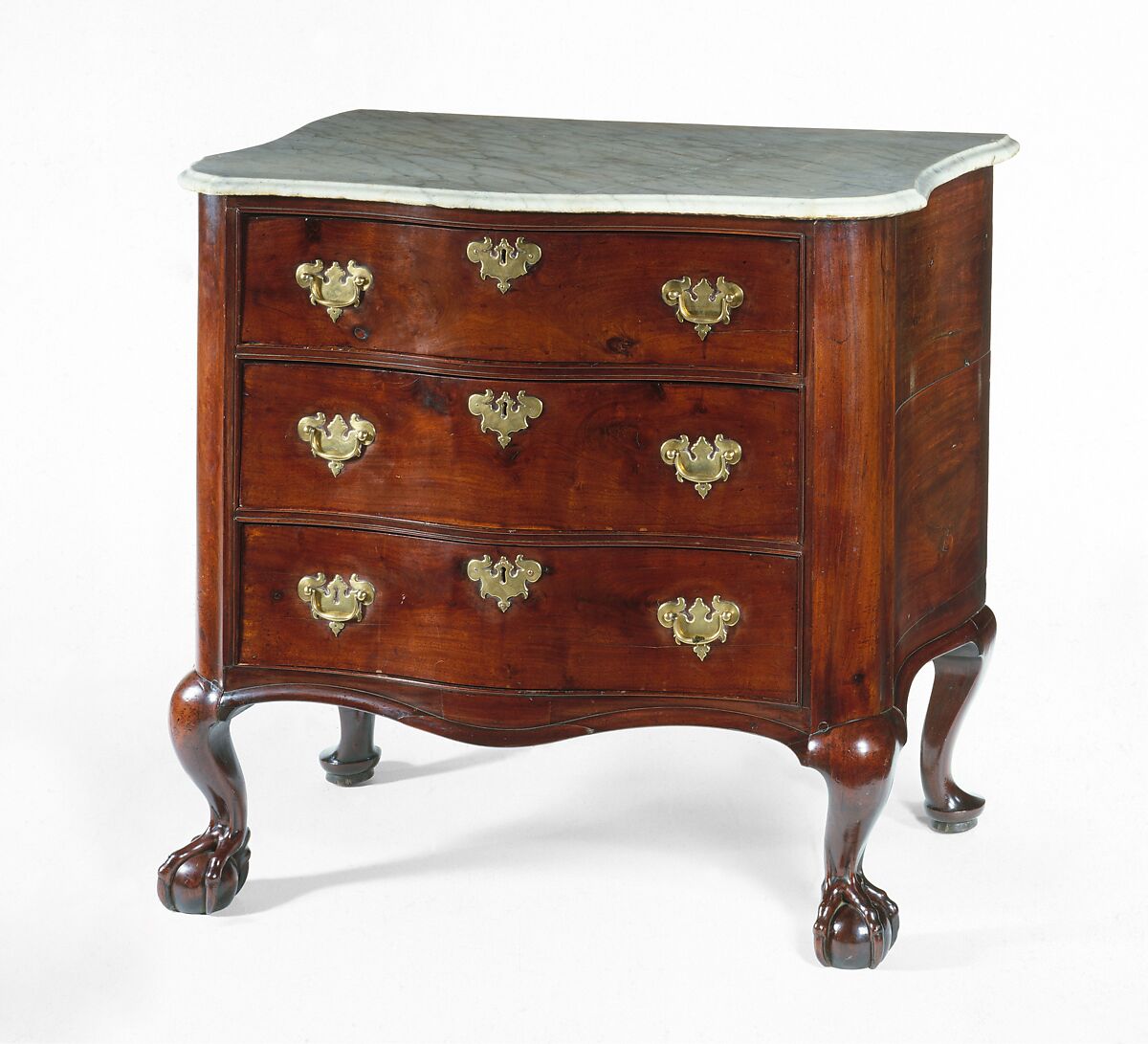
Chest of drawers attributed to John Goddard, 1755–85. Mahogany, white pine and chestnut. The Metropolitan Museum of Art, object 1972.130a, b. Public domain.
The Met associates the chest with a group of Newport furniture through its bold serpentine shape, solid form, serpentine corner posts, rear feet and claw-and-ball front feet. The attribution does not rest on one decorative motif. It comes from a constellation of related design and construction characteristics compared with documented work.
This is the correct use of silhouette: not as a shortcut to a famous name, but as the first layer in a cumulative attribution.
When a copy has an excellent silhouette
Silhouette is powerful, but it is not infallible.
A highly skilled nineteenth-century copyist could reproduce an eighteenth-century form with considerable accuracy. The Wallace Collection’s research into a corner cupboard copied from a Riesener original demonstrates how close a reproduction may become. Some original and copied gilt-bronze mounts were even exchanged between the two cupboards, complicating later assessment.
The lesson is important: a correct silhouette establishes design understanding, not necessarily date.
Once the overall design convinces, move inward:
- compare construction with secure examples;
- examine materials and manufacturing techniques;
- assess surface history;
- identify later technologies;
- verify mounts and hardware;
- research provenance.
The better the copy, the more disciplined the complete examination must be.
Regional and workshop variation
Do not confuse unfamiliar proportion with poor proportion.
Regional traditions developed distinctive solutions. Country furniture may preserve forms after metropolitan workshops had moved on. Export markets, available timber, household requirements and local working practices all affected silhouette.
A serious assessment asks two separate questions:
- Is the design coherent?
- To which tradition might that coherent design belong?
An object should not be rejected merely because it fails to resemble the best-known London example. Equally, “provincial” must not become an excuse for incoherent construction or invented design.
Museum collections, period pattern books, documented workshop groups and securely provenanced regional examples help build the necessary visual vocabulary.
Common silhouette warnings
Investigate further when you see:
- a top visually too large or too small for its support;
- a tall case that looks shortened or top-heavy;
- feet unable to carry the apparent weight above;
- inconsistent leg spacing;
- mismatched curves;
- a cornice unrelated to the base;
- an upper cabinet sitting uncomfortably on its stand;
- different negative spaces on either side;
- a chair back unrelated to its seat and underframe;
- decorative detail concentrated where structural resolution is weak;
- symmetry that is mechanically perfect where hand work should create subtle variation;
- exaggerated “period” features competing for attention.
These are prompts, not verdicts.
A disciplined twenty-foot examination
Before touching the furniture, record the following.
Front view
- What is the dominant shape?
- Where is the visual centre of gravity?
- How is the elevation divided?
- Do upper and lower sections belong together?
- Are both sides balanced?
- Is ornament integrated or applied?
Three-quarter view
- Does the depth agree with the front?
- Do projections and returns make sense?
- Does the base occupy the correct footprint?
- Are curves continuous around the carcass?
Side view
- Is the object unexpectedly deep or shallow?
- Is there evidence of reduction?
- Do rear supports belong to the same design?
- Does the stance remain convincing?
Initial hypothesis
Write a provisional description before inspecting construction:
> “The outline suggests a late seventeenth-century British cabinet on stand, but the stand appears visually light and should be tested for later replacement.”
This prevents the close examination from becoming an aimless search for age. It also makes the reasoning transparent: the hypothesis may be confirmed, refined or rejected.
Moving from silhouette to proof
After the distant assessment:
- Examine timber choice and veneer layout.
- Trace mouldings and carving.
- Study the surface and pattern of wear.
- Compare exposed and protected colour.
- Inspect construction, drawers and secondary woods.
- Read dovetails and tool marks.
- Assess hardware and fixing holes.
- Identify repairs, replacements and marriages.
- Check marks and documentary history.
- Return to the distant view and test whether the complete story now makes sense.
This sequence is the foundation of [How to Date Antique Furniture: An Expert Guide from Design to Construction](/guides/how-to-date-antique-furniture-evidence-timeline).
Final principle
A silhouette does not give an exact date. It tells an experienced observer whether the design speaks the right language.
The most useful first judgement is not “this is definitely 1720.” It is:
> “This piece has the proportion and line expected of its claimed period. I now know where to look for confirming or conflicting evidence.”
That distinction separates connoisseurship from guesswork. The eye begins the investigation; construction, surface and documentary evidence complete it.
Research references
- [The Metropolitan Museum of Art: British cabinet on stand, about 1700](https://www.metmuseum.org/art/collection/search/204655)
- [The Metropolitan Museum of Art: British cabinet on stand, about 1695–1700](https://www.metmuseum.org/art/collection/search/195525)
- [The Metropolitan Museum of Art: chest attributed to John Goddard, 1755–85](https://www.metmuseum.org/art/collection/search/2020)
- [The Wallace Collection: later corner cupboard copied from a Riesener original](https://www.wallacecollection.org/explore/explore-in-depth/riesener/the-furniture/cupboards-and-chests-of-drawers/corner-cupboard-f276/)
- [Victoria and Albert Museum furniture collection](https://www.vam.ac.uk/collections/furniture)